





Every printing company has its own growth strategy. Some businesses need to automate their production immediately, while others prefer to begin with a more affordable solution and gradually expand their production capabilities as order volumes increase.
Flexibility, short delivery times and the ability to process even small print runs efficiently are essential in today’s digital printing environment. As a result, more printing companies are bringing finishing operations in-house. This gives them greater control over delivery times and quality, reduces their dependence on external suppliers and enables them to offer customers a wider range of services.
Smyth provides solutions for different stages of production development – from the first steps in thread book sewing to fully automated production.
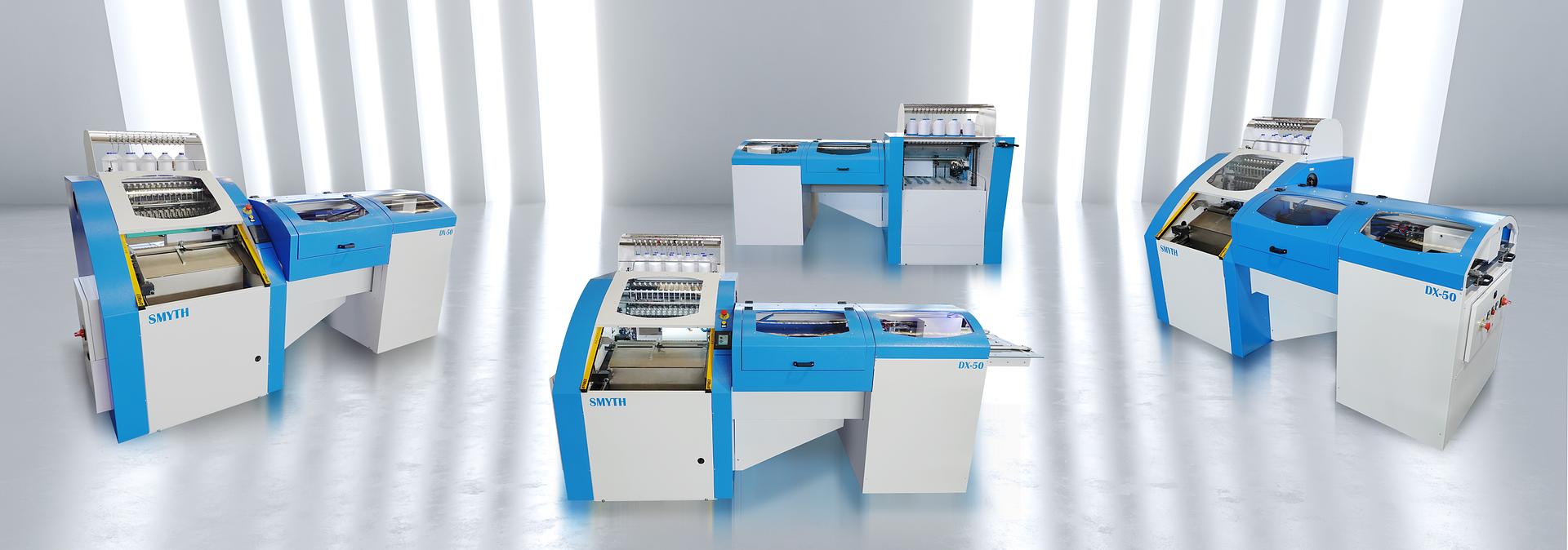
Smyth DX-50: a gradual entry into in-house production
The Smyth DX-50 semi-automatic system is designed primarily for short runs, print-on-demand, sample production and non-standard formats. Its simple operation makes it possible to produce high-quality thread-sewn books even without extensive previous operator experience.
It offers printing companies an affordable way to bring this type of finishing process in-house, expand their range of services and gradually develop the necessary expertise – without requiring a major initial investment.
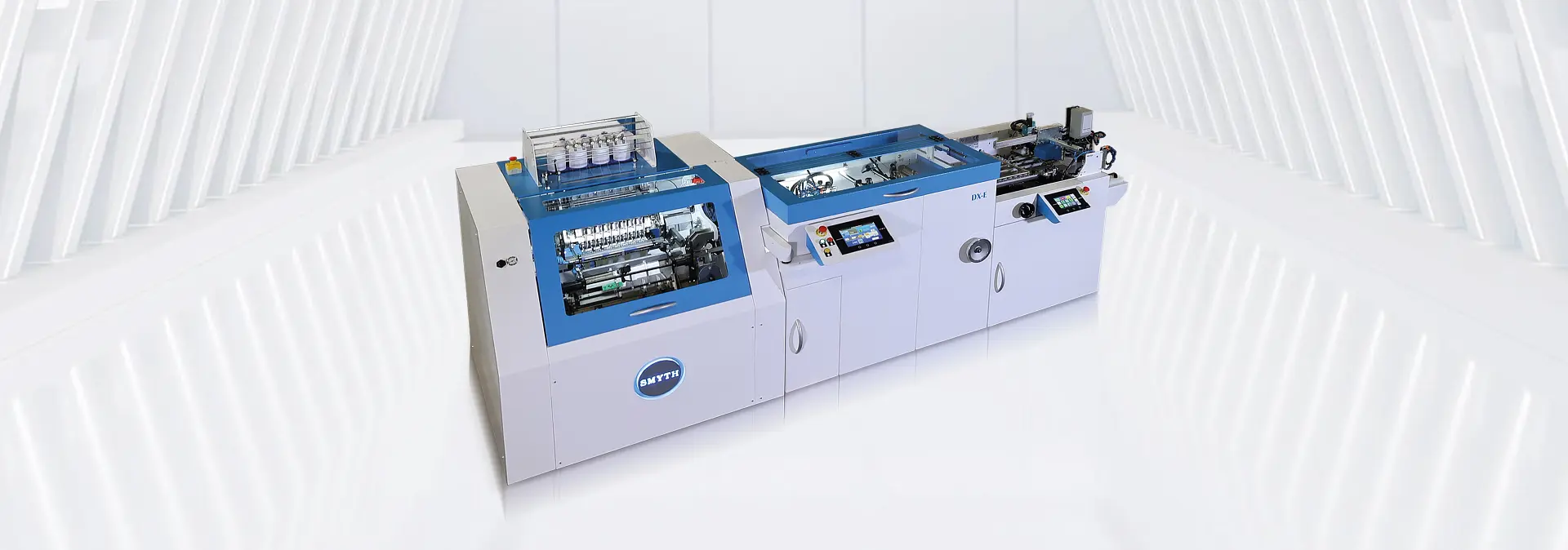
Automation with the Smyth DX-E
As order volumes grow, the demands placed on productivity and speed usually increase as well, together with the need to reduce manual operations. The fully automatic Smyth DX-E folding and sewing system is designed for this next stage. It processes digitally printed books and catalogues made from four-page inserted signatures.
This compact system is suitable for small and medium production runs. Optional readers for 1D and 2D barcodes and Data Matrix codes enable automatic verification of signature sequencing and variable book block composition. This reduces the risk of errors, shortens job setup times and simplifies the operator’s work.
Technologies that grow with your printing business
Moving towards automation does not necessarily mean that the original equipment must be taken out of service. The semi-automatic machine can continue to handle samples, short runs and special jobs, while the automated system processes higher production volumes. This allows printing companies to distribute work efficiently, make better use of their staff and maintain the flexibility they need.
Smyth also offers the option of buying back the semi-automatic machine. Used equipment then undergoes thorough refurbishment and can return to the market as a proven and more affordable alternative.
Every company has different production volumes, objectives and development timelines. It is therefore important to choose technology that meets current requirements while continuing to create value throughout the company’s future growth. Smyth solutions make it possible to invest gradually and sustainably without compromising the quality of the finished product.